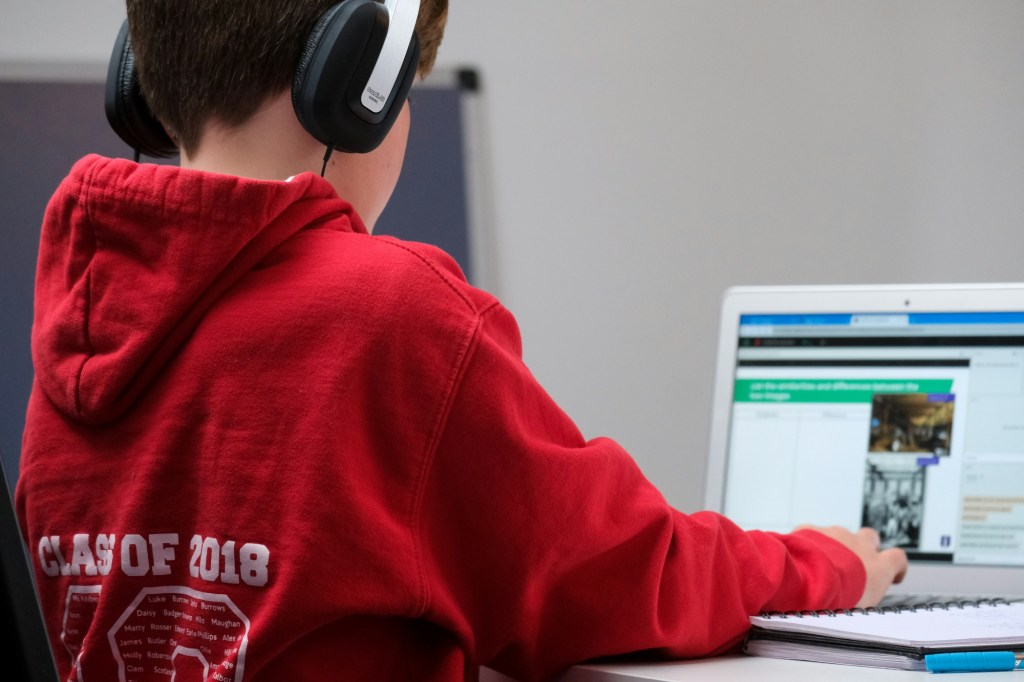
When a school district announces it has gone “1:1” with Chromebooks, administrators often tout it as a major step toward digital literacy. But I wonder if we’ve made a critical error: have we confused access to technology with learning about technology? And perhaps more importantly, have we replaced proven learning tools with screens in the name of progress?
The 2023 UNESCO Global Education Monitoring Report raises this question powerfully in asking “Technology in Education: A Tool on Whose Terms?” The answer in most schools appears to be “on the tech companies’ terms,” not our students’ terms.
Digital Literacy ≠ Using Computers for Everything
Digital literacy—the ability to use technology to find, evaluate, create, and communicate information—is indeed a crucial 21st-century skill. But here’s what I think we’ve gotten wrong: we don’t develop digital literacy by replacing pencils with styluses and books with PDFs. We develop it through intentional, focused instruction about technology itself.
Consider this: teaching a third-grader to write a book report in Google Docs instead of on paper doesn’t make them digitally literate. It makes them a less effective learner using a digital tool. But teaching them how to evaluate online sources, understand digital citizenship, or create multimedia presentations? That’s digital literacy.
What’s your experience been? Have you seen this distinction blur in your schools?
The Research Raises Serious Questions About Screens in Elementary Learning
The evidence that’s emerged over the past decade gives me pause about how we’re using technology in elementary classrooms:
Reading Comprehension: Multiple meta-analyses confirm that students comprehend less when reading on screens versus paper. A 2020 study of over 1,000 ten-year-olds in Norway found students scored significantly lower on digital reading tests than on identical paper versions. For elementary and middle school students specifically, research suggests digital reading may actually be detrimental to comprehension development.
Handwriting and Literacy: Research shows handwriting instruction in kindergarten improves letter recognition, phonological awareness, spelling, and word reading—foundational skills for literacy. When students handwrite, they activate brain regions associated with reading in ways that typing simply doesn’t replicate. The physical act of forming letters appears to help cement alphabetic knowledge in long-term memory.
Depth of Processing: Students reading on paper tend to read more carefully and reread important details. Students on screens often skim and process information more superficially—what researchers call the “shallowing hypothesis.” Physical books provide sensorimotor cues that may enhance cognitive processing: the feel of pages, the ability to flip back, the visual sense of progress through a text.
Attention and Retention: One study found that preschoolers who watched a story on screen performed significantly worse on attention tests six weeks later, exhibiting brain wave patterns similar to children with ADHD. Other research shows students taking notes by hand outperform those typing on laptops in both recall and conceptual understanding.
Are these findings consistent with what you’re seeing in classrooms? I’d love to hear from educators on the ground.
What the UNESCO Report Suggests
UNESCO’s findings offer an interesting framework for thinking about this. The report emphasizes that technology should complement, not substitute for human interaction and traditional learning methods. It suggests that digital tools should only be introduced when they are:
- Appropriate to the learning goal
- Equitable in access and impact
- Evidence-based in their effectiveness
- Sustainable over time
The report cautions that “beyond a moderate threshold,” technology use “may have a negative impact on academic performance.” Technology proved beneficial as a supplement—for extra practice, for reaching disadvantaged learners—but not when it “substituted for human instruction.”
As UNESCO Director-General Audrey Azoulay noted: “Online connections are no substitute for human interaction.”
This resonates with me, but I’m curious—does this align with what you’ve observed?
What Might a More Intentional Approach Look Like?
I’d like to propose a framework for discussion:
For Digital Literacy: Use computers purposefully—but to teach digital literacy specifically. Dedicate time to teaching students how to evaluate online sources, protect their privacy, create digital content, code, and navigate digital tools safely and effectively. This seems like authentic digital literacy instruction.
For General Learning: Consider defaulting to proven methods. What if elementary students:
- Read primarily from physical books, not screens
- Write and take notes by hand, not on keyboards
- Complete math problems on paper where they can see their work spatially
- Engage in hands-on, manipulative-based learning
- Receive face-to-face instruction from teachers as the primary mode
Appropriate Tech Use: Computers excel at certain tasks—collaboration tools, accessing information not available in print, assistive technology for students with disabilities, data visualization, multimedia creation. Perhaps these are the sweet spots for technology integration?
Questions Worth Exploring
A Chromebook on every desk isn’t necessarily digital literacy—it might just be expensive overhead that could be actively harming learning outcomes, particularly in elementary grades. I think it’s worth questioning whether we’ve conflated consuming content on screens with learning digital skills, and whether we’ve replaced effective learning tools with inferior digital substitutes.
What if our students could have both: rigorous, evidence-based instruction using methods that research supports (paper, pencil, books, and human teachers), and intentional, focused digital literacy education that genuinely prepares them for a digital world?
What would it look like if technology became a powerful tool we deploy strategically—on our terms, for our students’ benefit—rather than a replacement for the fundamentals?
I’d love to hear your perspective:
- Are you seeing screens enhance or hinder learning in elementary classrooms?
- How are you balancing digital literacy instruction with general learning?
- What’s working in your school or district? What concerns do you have?
- As parents, how do you feel about the amount of screen time in your child’s school day?
Let’s discuss in the comments. This feels like one of those issues where we need more honest conversation and less assumption that “new equals better.“
 Mona Soni
Leave a comment